Agressividade
Dog Aggressive With People or That Bites: What to Do
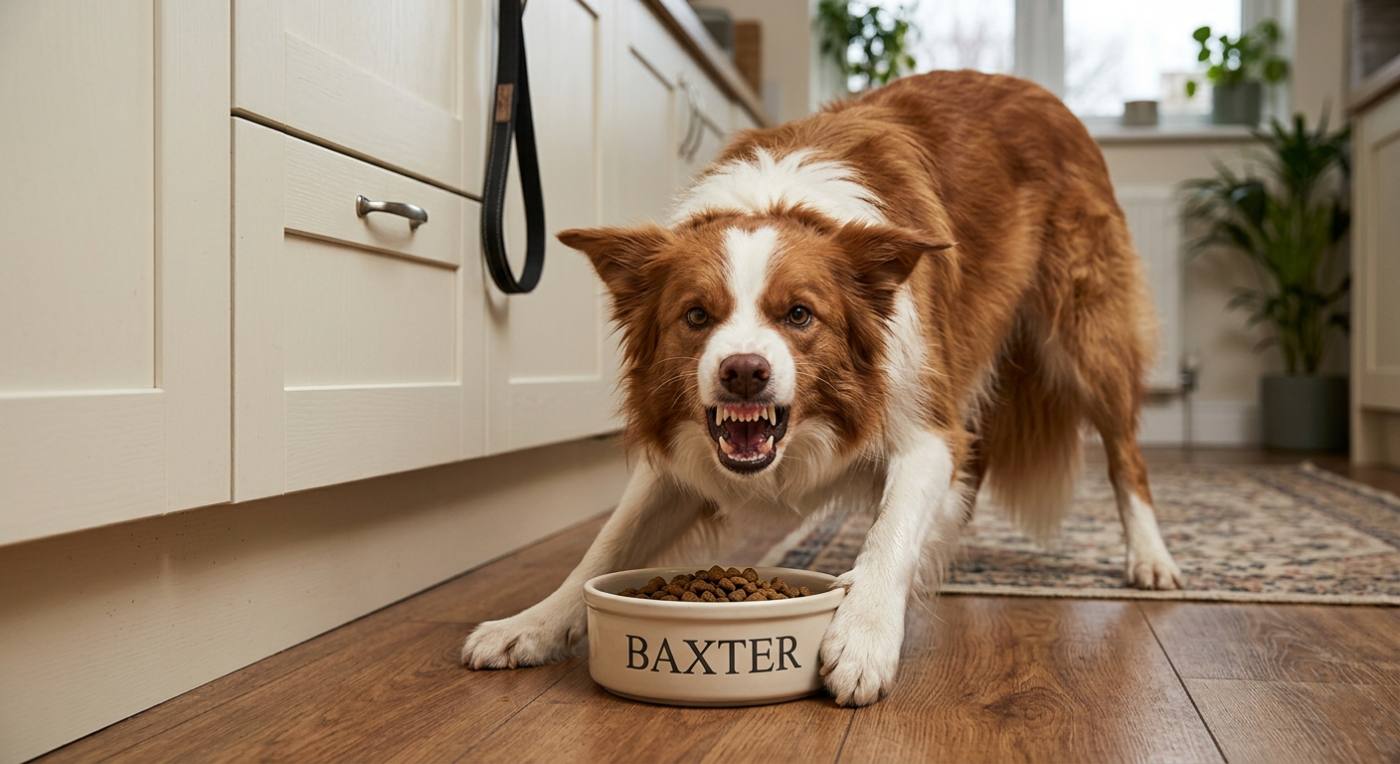
A dog that growls, lunges or bites people is almost always communicating fear, insecurity or defence — not badness, although in some cases that can happen. But unlike other behaviour problems, this one leaves no room for experiments: people's safety is at stake. The honest truth is that this is the scenario that most demands professional assessment, and the most dangerous one to try to solve alone.
Why a dog bites people. The most common patterns: fear of strangers, in the insecure dog that attacks to drive away whoever approaches; territorial defence, reacting to anyone entering the house, ringing the doorbell or coming near the car; resource guarding involving people, growling when someone approaches the food, the bed or an object; redirected aggression, in a dog at peak arousal or frustration that bites whoever is closest, sometimes the owner; handling, reacting to being touched, picked up, brushed or restrained, often because of past negative experiences; with children, which deserves double care; and the dog that has never been told no, which is not used to doing what it does not want and ends up biting when opposed.
The warning scale: no dog bites “out of nowhere”. Before a bite there are always warnings — looking away, going stiff, lip licking, showing the whites of the eyes, growling, baring teeth. The most dangerous mistake is punishing these warnings: a dog that learns growling brings punishment stops growling and starts biting without warning. The growl is not the problem; it is the information that keeps the dog predictable.
Safety first, while rehabilitation is worked on. Management does not rehabilitate, but it keeps everyone safe during the process: actively avoid known trigger situations until you have a professional plan; do muzzle habituation, positively and gradually, because a dog comfortable with a muzzle allows safe work and protects everyone — it is not punishment, it is responsibility; manage the door and visitors, with a safe space for the dog when people arrive, or a leash if needed, never receiving visitors with the dog loose; and never force approaches “so he gets used to it”, because above threshold this reinforces the bad association and increases risk.
Dogs and children: zero tolerance for risk. With children the rule is simple and non-negotiable: 100% active supervision and never leaving dog and child alone, even with a dog with no history. Children move unpredictably and do not read the dog's warnings. If your dog has shown any sign of tension around children, seek professional help immediately and apply full environment management until then.
How rehabilitation works. The path is the same as in other aggression cases, with safety always first: manage the environment, keep the dog below threshold, and change the association with people through desensitisation and counter-conditioning — the stranger, the visitor or the touch start predicting good things instead of threat. And, as always, I train the owner as much as the dog: they are the ones living with the animal and the ones who must know how to handle each situation safely when the trainer isn't there.
Legal and liability aspects. A dog that bites people is also the owner's legal responsibility. In Portugal there is specific legislation for dogs considered dangerous or potentially dangerous. Working with a professional certified in this area, with PSP and DGAV certification, helps you not only rehabilitate the dog but also meet your obligations and protect yourself.
Frequently asked questions. My dog bit someone — is there a solution? In most cases, yes — with professional rehabilitation and proper management; a bite history is not a sentence, but it demands serious assessment and a tailored plan. Why does my dog bite me, the owner? It is usually redirected aggression, resource guarding or a reaction to handling. Should I punish my dog when it growls at someone? No. Punishing the growl teaches the dog to bite without warning. Is a muzzle cruel? No, when introduced positively; it is a responsible safety tool. Can I solve this on my own? This is the case where going it alone carries the most risk — people's safety allows no trial and error.
Need help with a dog that is aggressive with people? If your dog growls, lunges or bites people in Greater Lisbon, Cascais, Oeiras — or you need remote guidance — the most important and most urgent step is a professional behavioural assessment.
Need help with your dog? André Alves works at home across Greater Lisbon and online worldwide.