Reatividade
Leash-Reactive Dog: Why It Happens and How to Solve It
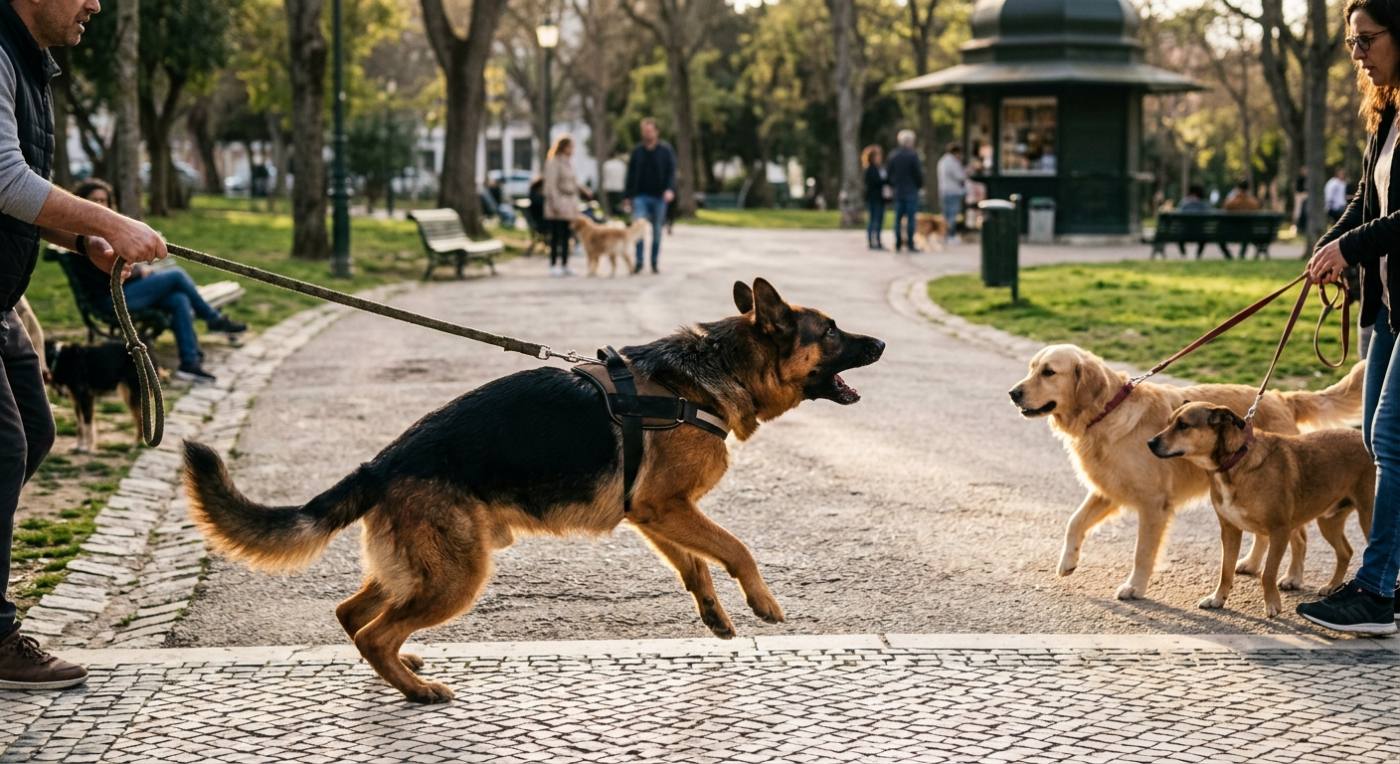
Leash reactivity is when a dog that is usually sociable, or even calm, transforms on the leash — barking, pulling, growling or lunging as soon as it sees another dog, a person or a stimulus. The most telling sign is this: many of these dogs behave completely differently off leash. If you recognise this, the problem is not your dog's temperament — it is what the leash makes it feel. It is one of the most common cases I work with, and also one of the most responsive to rehabilitation.
Why the leash changes everything. Off leash, a dog has options: approaching in a curve, moving away, reading the other dog's body language, creating distance. On the leash, all those options disappear. It has no way out — and it is that sense of being cornered that sets off the reaction. Three forces usually combine: barrier frustration, in the sociable dog that wants to reach the other dog and, blocked by the leash, explodes into barking and pulling; fear with no escape, in the insecure dog that, loose, would move away and, restrained, attacks first to drive the threat off; and the opposition reflex, in which tension on the leash creates more tension, the dog pulls against the pressure, the owner pulls back, and the cycle feeds itself.
The invisible role of your hand on the leash. The dog feels your state through the leash. The moment another dog appears in the distance, the owner anticipates the worst, shortens the leash, holds their breath — and has just told the dog, without a word, that there is reason for alarm. Tension on the leash is a conversation. Much of leash rehabilitation is, in fact, teaching the owner to keep a loose hand and a calm mind.
How to solve leash reactivity — in practice. Work below threshold: start at the distance at which the dog sees the trigger but can still think and hear you. Change the association through counter-conditioning: at the right distance, make the appearance of the trigger predict something good, until “another dog” stops meaning conflict. Loose leash as the baseline: a dog held in constant tension is always ready to react. Give a clear way out: teach a calm manoeuvre to create distance, a fluid change of direction, and the dog learns there is an option other than reacting. And start the walk already calm — a dog that leaves the house in euphoria reaches the street above threshold; calm is built before the door.
Equipment: what helps and what makes it worse. Extendable (flexi) leash: terrible for reactivity — permanent tension and zero control at the critical moment. Fixed leash of 1.5 to 2 m: the right basic, gives control and allows slack. Collars: the choice depends on the dog and should be assessed case by case — equipment manages the behaviour while you work, but never replaces rehabilitating the emotion underneath.
Mistakes that consolidate the problem: pulling the leash and shouting when the dog reacts, which adds the tension that feeds the reaction; switching to night walks “so we don't meet anyone”, which avoids the problem instead of solving it and reduces the dog's tolerance even further; approaching to “say hello and get used to it” above threshold, which seals the bad association; and swapping equipment hoping for a miracle — the tool helps manage, it does not rehabilitate on its own.
Frequently asked questions. Why is my dog only reactive on the leash? Because restrained it loses the options it would have loose; with no escape, frustration or fear intensify. Can a leash-reactive dog walk calmly? Yes. By working on distance to the trigger, the association and slack in the leash, the great majority of these dogs start passing others calmly. Does an extendable leash help? No, it makes things worse. My dog is friendly off leash but a “monster” on it — how is that possible? It is the classic pattern of leash frustration: the dog wants to interact, the leash prevents it, and frustration turns into reaction. It is not aggression — it is a lack of direction. Should I avoid other dogs on walks? At the start, managing distance is part of the work; but avoiding forever does not solve it.
Need help with a leash-reactive dog? If walks have become a source of stress in Greater Lisbon, Cascais, Oeiras — or at a distance, with online coaching — the first step is a 360º Assessment to understand what lies behind the reaction.
Need help with your dog? André Alves works at home across Greater Lisbon and online worldwide.