Reatividade
Reactive Dog: What It Is and How to Rehabilitate It
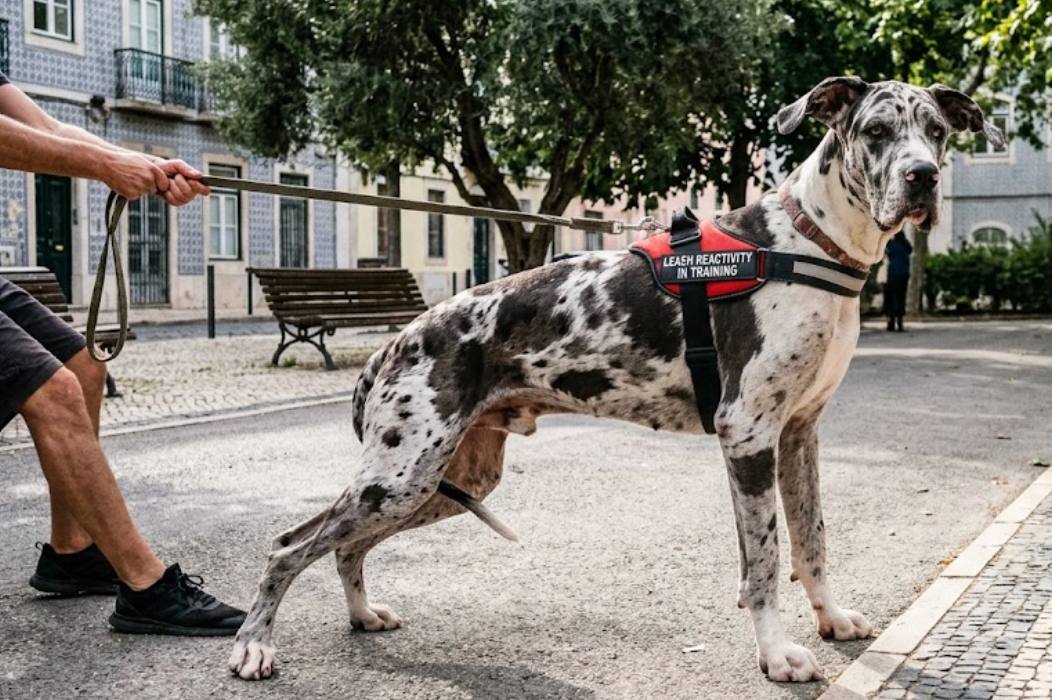
A reactive dog is a dog that reacts in an exaggerated, uncontrolled way to a trigger — another dog, a person, a noise, a car — usually out of fear or frustration, not out of badness. Barking, jumping, pulling, growling or lunging are the most common forms. The good news is that reactivity is one of the most rehabilitable problems there is, as long as you treat the emotion underneath — and not just the behaviour on the surface.
Reactivity is not aggression (and confusing the two costs months). Reactivity is an exaggerated emotional reaction to a trigger: the dog is in panic, frustrated or overwhelmed, and there is rarely any real intent to injure — all the noise is, most of the time, an emotional discharge. Aggression is when there is intent to cause harm. Most dogs people call “aggressive” are in fact reactive. And treating reactivity as if it were aggression — punishing, confronting — only increases the fear and makes everything worse.
Signs of a reactive dog: barking, growling or lunging at specific triggers such as dogs, people or bicycles; pulling sharply on the leash at the sight of the trigger; being in a constant state of alert on walks, unable to relax; coming home more agitated than when it left; freezing, trembling or trying to flee, because reactivity also has the face of passive fear.
Why your dog is reactive: fear — it learned that attacking first drives away what scares it; frustration — it wants to reach the trigger and the leash prevents it; lack of socialisation as a puppy, with no “vocabulary” for dealing with the world; a bad experience that created a negative association; genetics and temperament, because some dogs are born more sensitive to stimuli.
The concept that explains everything: the reaction threshold. Every dog has a threshold — the distance or intensity beyond which the trigger makes it “explode”. Below threshold, the dog notices the trigger but stays able to think and to hear you. Above threshold, the emotional brain takes over and no command works. Connected to this is trigger stacking: a dog that already left home stressed, heard a motorbike and passed a cyclist arrives at the next dog already “full” — and reacts to something it would ignore on a calm day. It is not stubbornness; it is a saturated nervous system.
Why obedience alone does not solve it. Asking for a “sit” from a dog above threshold is like asking someone in a panic attack to do mental arithmetic. The thinking brain is offline. That is why so many owners train for months with no result: they are training on top of an emotion. You change the emotion first; obedience comes after.
How a reactive dog is rehabilitated. Serious rehabilitation follows an order and does not start with commands: safety, managing distance and environment so the dog never goes past its comfortable threshold during training; regulation, teaching the dog to lower its own state of arousal; direction, giving it something clear to do instead of reacting; pressure and limits, communicating fairly what is acceptable, at the right moment; and obedience, only at the end, once the dog is emotionally stable. Underneath, two processes are at work: desensitisation and counter-conditioning, with precision in distance, timing and body-language reading. And there is one track almost nobody works on: the owner. The dog feels everything through the leash. That is why my work is always done in pairs — I rehabilitate the dog and teach you to train it too.
Can a reactive dog be cured? “Cure” is the wrong word — we talk about rehabilitation and management. In the vast majority of cases, a reactive dog improves very significantly: it starts passing triggers calmly, and the owner gains tools to handle any situation. The earlier you intervene, the faster and lighter the process. But faced with sudden triggers outside anyone's control, it may still react.
Mistakes that make reactivity worse: punishing the growl, because the growl is a warning and a dog that learns not to warn starts reacting without warning; forcing exposure, thinking “the more it sees, the better”, when above threshold you train exactly what you want to eliminate; using dog parks as “therapy”, uncontrolled chaos that consolidates the reaction; yanking and shouting at every reaction, which adds tension and a bad association; and waiting for it to pass with age, when untreated reactivity consolidates and gets worse.
Frequently asked questions. What is the difference between a reactive dog and an aggressive dog? Reactivity is an exaggerated emotional reaction, almost always without intent to injure; aggression involves real intent to cause harm. Can a reactive dog become calm? Yes, with rehabilitation that works on the emotional cause and on distance to the trigger. How long does it take? It depends on the cause, the intensity and the owner's consistency; many cases show clear improvement within a few weeks and consolidation takes a few months. Can I rehabilitate a reactive dog on my own? It should always be guided by an experienced, certified professional, because any mistake, however small, can cost the dog's progress. My dog is only reactive on the leash — why? Restrained, the dog loses the option to flee or approach naturally, and fear or frustration intensify.
Need help with a reactive dog? If your dog reacts to other dogs, people or stimuli in Greater Lisbon, Cascais, Oeiras — or at a distance, through worldwide online coaching — the first step is a behavioural assessment to identify the real cause.
Need help with your dog? André Alves works at home across Greater Lisbon and online worldwide.